
Kenya Details
Welcome to your Kenya Guide for your CRAFT & CULTURE Tour, June 21-30, 2027.
This guide is filled with details to help you plan for this amazing tour. Please bookmark this page so you can easily reference this link as you prepare these coming months.
If you have any questions, please don’t hesitate to reach out. Looking forward to our adventure in Kenya together!
Itinerary
-
Welcome to Nairobi! Meet your driver from Ololo Lodge outside of customs.
Transfer to Ololo, a sustainable Safari Lodge, situated right on the edge of the Nairobi National Game Park.
All our delicious meals are sourced from the regenerative farm on the premises.
Relax and enjoy the artisan-made and locally sourced decor and the beautiful gardens if you arrive early.
Dinner available for those arriving at the center by 8:00 pm. Otherwise, later arrivals will check in and immediately get ready for a good night of rest!
Our welcome meeting will be at breakfast tomorrow morning.
-
Welcome breakfast at the lodge.
Morning safari followed by visit to the elephant orphanage.
Lunch at a fav local spot in Karen.
Afternoon visit to the Giraffe Center and shopping at local artisan based shops.
Afternoon safari back to Ololo followed by dinner.
-
Sunrise safari to find some of the incredible wildlife in the park.
Breakfast at the lodge
Tour of the regenerative farm at the lodge
After lunch, walk to Kitengala Glass for a glass blowing session with the artisans at their magical workshop.
Evening safari to view the wildlife at sunset.
Dinner at the lodge.
-
Breakfast at the lodge.
Depart to visit the world of Kenyan crafts at a small workshop and creative studio in Nairobi, owned by one of ARTIST & NOMAD’S benefactors.
See firsthand where local artisans make beautiful leather goods, brassworks, and ceramics, and learn about traditional techniques, and even try your hand at a few of the steps alongside the talented team.
A delicious local lunch will be prepared for us on-site.
Return to Ololo for a relaxing afternoon at the lodge. Swim, read, rest.
Optional sunset safari in the park
Dinner at the lodge
-
Breakfast at the lodge
Depart for the Maasai Mara to begin your three day safari
Arrive to Basecamp Wilderness. Perhaps more than any of the other Maasai Mara camps, Basecamp Wilderness pays homage to the safari pioneers of a bygone era. At the same time, its unique location within the Naboisho Conservancy allows for a very modern approach to responsible tourism.
Offering an exceptional degree of exclusivity to guests looking to enjoy a safari in the Maasai Mara, this Kenya safari tented camp benefits from being sited in a wildlife conservancy away from busier parts of the reserve. Basecamp Wilderness offers incredible views – especially at at dawn as the sun begins to rise– and also invaluable glimpses of the lives and times of Kenya’s legendary early explorers.
Sunset Safari and dinner at the camp.
Hidden deep within the evocatively named Saddle Valley, Basecamp Wilderness offers stunning sunrise views and abundant wildlife.
Basecamp Wilderness is a founding member of Naibosho Conservancy.
It is an important community-owned wildlife area in the Masai Mara ecosystem whose success has helped changing the story of tourism and conservation in the Masai Mara, improving the livelihoods of people and extending the size of protected land where fauna and flora thrive.
-
Breakfast at camp.
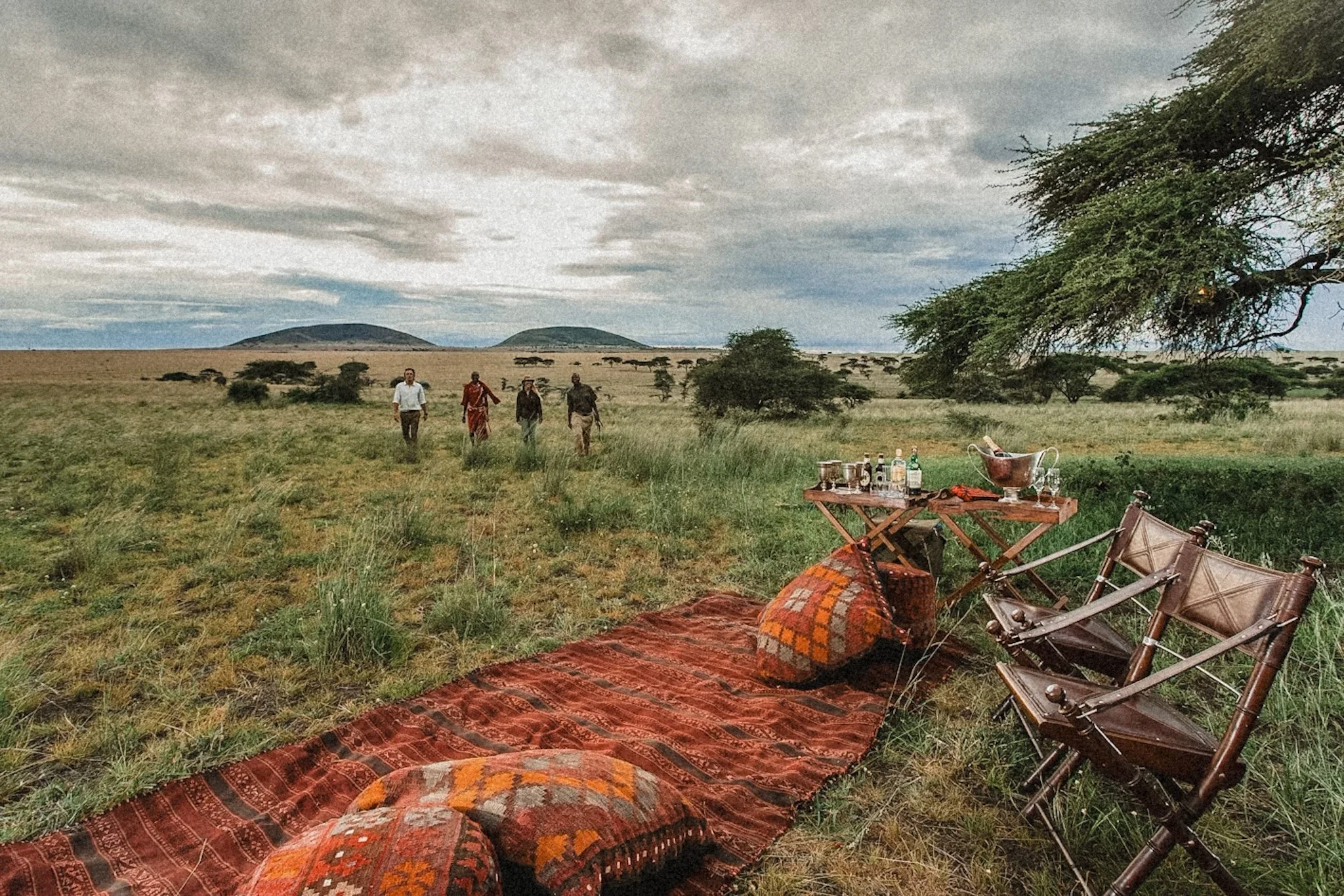
Morning bush breakfast and sunrise safari
Lunch back at camp.
Afternoon bush walk with a local Maasai guide.
Dinner and campfire stories with the Maasai.
-
Morning Sunrise Safari.
Return for breakfast and refreshing up.
Bush picnic and bird watching
Afternoon visit to a local, authentic Maasai village - learn about their local culture and traditions.
Dinner at the camp followed by a nighttime game drive. See the different animals that come out at night!
-
Wake up to your last day in the Mara.
Enjoy a final early safari or sleep in for a slow, relaxing morning.
Pack up your belongings and prepare for the final leg or our journey - Lamu Island!
Depart for lamu. Transfer to Lamu Island, on Kenya's north coast, is a dreamy sand-and-sea destination. We will be staying at Kijani House, a grand old colonial mansion located in the quaint village of Shela, just south of Lamu Town. The hotel has front-row access to the beach and the incredible sunsets over the water. There's a gorgeous garden, lush with palms, albizias and bougainvilleas and two sparkling swimming pools.
Relax, walk the beach, and enjoy the beautiful house.
Sunset Dhow boat cruise followed by dinner at the house
-
Morning visit to Lamu Town with a local guide. Only 5 minutes by boat, Lamu Town is a UNESCO World Heritage site. You will be transported directly into the seventeenth century. No cars, narrower and narrower alleys and streets as forming a labyrinth from where the children playing will easily guide you if you get lost.
Lunch at Lamu House followed by a visit to the donkey sanctuary
Return to Kijani House to relax or do some local shopping and exploring of Shella Beach
Final dinner and time of sharing about our incredible adventure in Kenya together
-
Enjoy a final morning and breakfast on the island of Lamu
Pack up and prepare for our flight back to Nairobi
Stop at the Homecare Retreat Center to relax and have a final meal before your departure
Late departures home. Those going to Neema will stay an extra night at the retreat center.
Safe journey home! We hope you carry a lifetime of memories, experiences, and relationships with you that continue to inspire you and impact you for years to come.
Travel Details
-
Booking Flights: We suggest booking flights 4–9 months before the tour.
Arrival Airport & Time:
Airport: Nairobi
Plan to arrive Nairobi on an afternoon or evening flight. The earlier the better, but often most flights form the US arrive between 8-10pm.
Customs + Transportation: It takes about 2+ hours to get through customs and transfer to the accommodations in Nairobi.
We will arrange your transfer from the airport to the hotel based on your flight itinerary.
Lodge: Check-in is at 3:00 pm. If your flight arrives early, you can still head to the hotel, but your room may not be ready till 3:00 pm. There will be places for you to relax until check in. Most of you will be arriving on the evening flights.
Departure Airport & Time:
Airport: Your return flight should also be from Nairobi.
You should book one of the evening return flights between 7pm and midnight on June 30th. This will ensure you have time to transfer from Lamu to Nairobi. We will try to arrange a lunch or early dinner for you depending on the final itineraries.
Details about the schedule for our final day will be updated once all return flights are booked.
Please provide your itinerary in the document section (right column) of this guide along with your travel insurance and copy of your passport.
-
At Customs, you will need to state you are staying at:
Ololo Safari Lodge
Exchange some Cash at the airport in baggage claim. You can use an ATM machine or money exchange. The rate is not great. Alternatively, most of the places you are staying will accept credit cards. You will want some USD to exchange for direct purchases from smaller artisans as well as extra tips for our guides and hotels.
Meet your driver outside the airport after you exit. Look for a sign that says: Ololo Lodge - ARTIST & NOMAD
Since many people will arrive at different times, our first group meeting (welcome meeting) will be at breakfast on our first full day.
For those who arrive before 8pm, you can have a formal dinner. Those arriving late and hungry can request a snack before you retire.
Once you arrive to Ololo lodge, they will check you in with your passport and help you get settled in your room. You will likely be tired and ready to sleep!
-
We will coordinate all your transportation in Kenya, including airport transfers and in-country flights to the Masai Mara and Lamu. All local transportation is included in your tour costs. We will cover the tips for transportation as well.
-
We will keep you busy the first few days to help combat jet lag.
Eat healthy 24 hours before flying.
Eat healthy during flights.
Bring compression socks to help with circulation and swelling.
Bring a reusable water bottle and stay hydrated before, during, and after flight.
Bring ear plugs and eye mask for the flight and sleeping.
Bring melatonin or other sleep aids.
-
Photographs: Kenya is beautiful ad inspiring. We are sure you will want to take many photos. There will be times when it is not appropriate to be taking photos, and we will let you know. Please use restraint when we are being hosted as a group - we will share photos as to not overwhelm our local friends.
We will create a shared album for a daily airdrop of photos for group shots + add your photos to share.
We ask that you restrain from taking images that don’t honor the local culture or people. Also, be sensitive to taking photos of people or children you do not know- ask permission if someone wants their photos taken before you take it.
Social Media: Share what inspires you on social media. Tag ARTIST & NOMAD and our local partners as a way to honor them and inspire others to explore social impact travel. @artist.and.nomad
-
The overall philosophy is to not plug in unless you really need to. We want you to be fully present for your Kenyan adventure!
Phone Plan: Check with your mobile phone plan to verify what you need for this trip. Please plan being able to receive messages via WhatsApp, as that is how we will communicate as a group throughout the trip.
WiFi: Is available at our hotels, but it’s not always reliable. The early mornings and late evenings at the hotel will be a time you can connect before or after meals if needed.
WhatsApp: We will use WhatsApp for our group messages. It is also great for communicating with your loved ones at home during your trip.
-
TIPS: All meal tips and local transport tips are already included in your tour. However, we ask for you to contribute towards the tips for those who offer us hospitality (hotels and guides.)
Please plan to give $10/night/ person for each accommodation ($90 total for all 9 nights) as well as $20 a person/day for our safari tour guides (4 days) - a total of $170 a person for tips. This may seem like a lot, but this is the main way the people serving you in the hotels and as safari guides know they did a good job and earn their living. You will be invited to leave a tip in the tip jars of each accommodation for the hotel staff. You can tip the safari guide in both Nairobi and Masai Mara directly at the end of our stay in each place.
Artist + Nomad will also be leaving a base tip from the group, but the above amount will make a big difference in the people offering hospitality if you are pleased with the service and experience at each place.
Travel Documents + Health Information
-
Please upload a photo of your passport.
Must have 3 blank pages and not expire 6 months before the return date of your trip.
Bring a copy of your passport with you.
-
Please upload a copy of your flight itinerary in PDF or JPG form here.
-
Please upload a copy of your travel insurance policy in PDF or JPG form here.
Select a plan level from a company of your choosing that brings you the most peace of mind. For the most complete protection—such as “Cancel For Any Reason” or coverage for pre-existing medical conditions—be sure to purchase within 21 days of your ARTIST & NOMAD deposit, if you want it to include your A&N tour fees.
Squaremouth(A&N has no affiliation) has a variety of travel insurance options to compare.
-
You will need to apply for a visa in order to enter Kenya. Here is the website for the visa: https://etakenya.go.ke/
You can apply within 3 months and 2 weeks of your trip. It will take a few days to get a response.
A few details you need for your visa:
Jim Chapman, Ololo Safaris, +254 792 606919
Accommodations: OLOLO Lodge, Nairobi National Park
Purpose of Travel: Tourism
-
Pharmacy & Medical Clinics: Your host will have a small first aid kit, but you should bring anything you think you need, especially personal medications and any travel meds from your doctor, such as malaria meds. If needed, emergency medicines are available in local pharmacies in Nairobi, but we will be limited when we are on safari.
Health Insurance Card: bring a copy of your regular health insurance card .
Yellow Health Card or Shot record: Be sure to bring this or your shot record as well as a digital photocopy on your phone. It is helpful to have your record handy in case of emergency.
Vaccines: Please visit your doctor or a travel nurse to discuss what is best for you. Your local pharmacies can often also advise.
You are responsible for ensuring you have the vaccinations or vaccination exemptions required for travel and entry into your destination.
Currently there are several vaccines recommended for travel to Kenya.
It is also discuss if you should get a malaria medicine for your time in Kenya. We will be in areas where that is recommended for travelers.
Nothing is required for entry, but we want you to stay healthy and safe, so please meet with a trusted doctor or pharmacy to discuss what you need to take or bring with you.
-
Health Policy: Please note that smoking and drug use are not permitted.
If alcohol is available on this tour at some of our accommodations, we kindly ask that you enjoy it mindfully and in moderation. Please note that smoking and drug use are not permitted.
Alcohol is not included in your trip costs unless noted by your guide (some of the lodges include an option for alcohol house drinks such as beer and wine). Otherwise, you will need to pay directly for alcohol when it is available. Please be sensitive to other guests and avoid any excessive drinking.
Packing Details
-
Checked Luggage
Pack light—you’ll be carrying your own bag.
We suggest bringing one small checked bag with an extra foldable duffle or large tote for souvenirs.
Because we take small in-country flights, we recommend a soft luggage for checking.
Your TOTAL limit for the smaller in-country flights is 33 pounds (including carry-on baggage.) If you make purchases in Nairobi at the artisan workshop, those can be held in Nairobi for you. They will be given to you before you depart on your last day so you don’t have to travel with them on the smaller flights to the Maara and Lamu.
Carry-On Bag
Pack essentials + medications and at least one change of clothes in case your luggage is delayed (this can happen). Consider adding a tracker to your luggage.
You may also bring a personal item (like a purse, backpack or camera bag), but check your airlines for their policies.
Small Waist Pack or Crossbody Bag
Great for keeping your passport, tickets, and documents handy.
Usually doesn’t count toward your carry-on allowance if small.
Perfect for exploring markets and keeping things secure.
You will be given an A&N tote to use during your tour as well!
-
Here’s a suggested packing list. We’ll go over details in our pre-trip meeting if you have further questions. Keep it light — you’ll re-wear clothes, and layers are key in Kenya. It is technically winter in Kenya, so the evenings will be cold/chilly, so bring at least one jacket or wool sweater. The day will be a mix of warm and cool depending on our location. There will also be some rain as it is the end of the rainy season. Check the weather before packing.
Clothing: Modest clothing is important. Many Kenyans are either conservative Christians or Muslims. Avoid shorts, miniskirts, tank tops, see-through, tight, or low-cut clothes. No flashy styles, torn clothes, or offensive t-shirts. Good options are dresses, tunics, pants/jeans with blouses or button-up shirts. Layers are good. Classic safari style works too!
4–5 casual outfits + 1–2 nicer outfits (you’ll repeat outfits)
Lightweight jacket + 1 sweater for cool evenings
When on safari, our guide will provide blankets in the jeeps as well.
Scarf for warmth.
Bring a hat for sun.
Lamu will be by the beach and warmer during the day
Undergarments + Socks:
Bring enough for the entire trip (pack an extra in carry-on) .
Socks: enough for trip and remember to bring a wooly pair for keeping warm at night.
Shoes
Comfortable closed-toe walking shoes.
Sandals comfortable for walking.
Swimwear
Swimsuit for the pool in Lamu and the Ololo Lodge. (Though it might be a little too cold to swim…weather depending!)
Bring a small bag for carrying a wet swimsuit.
Bring a dress or shirt that can be a coverup coming and going from the pool
Jewelry
Jewelry is fine, but leave valuables at home. You might want to buy lots of jewelry from the artisans you meet.
Misc
Bring a journal, pen, and book to read (maybe one from our list!)
Laundry
Available at some hotels (small fee, 24-hour turnaround).
Undergarments may not be included — bring enough or wash in the sink.
-
Toiletries: Liquids must be under 3.4 oz and fit in a clear quart size zip bag if you have them in your carry one bag. Remember to check other airport regulations if you have a connecting flight.
Personal toiletries (keep it as simple as possible).
Pack sunscreen, bug spray and hand sanitizer.
Whenever possible, try to choose eco-friendly products.
Keep your essentials in your carry-on so they’re easy to reach.
Hair Styling Tools:
There may or may not be a hair dryer available at our accommodations. It depends on the location. Plan to go natural with your hair when you are in the Masai Mara.
-
Pack Healthy Snacks such as nuts, bars, dried fruit, etc, that won’t spoil or melt.
You may want to pack extra snacks for the in country travel days as well.
-
Personal Medications: Please bring your regular medications + a few days extra and keep them in your carry on bag.
Sleep aids: Consider melatonin or other sleep aids that may be helpful during your first few days. I use a white noise app on my phone. Some folks also bring ear plugs.
Travel Medications: Ask your travel doctor to provide a prescription in case you contract a parasite and need an antibiotic, as well as prescription medications for diarrhea as well as malaria prevention. It’s better to be safe than sorry!
-
Electronics: Phone, charger, earphones, and a portable charger.
Plug Adapter(s): Kenya uses type G — same as what is used in the UK.
Kenya’s power: is 240V / 50Hz
-
Credit / Debit Card: ATMs in Kenya are limited, so having both cash and a card is important.
Call your bank or credit card company before travel so your card doesn’t get blocked.
Bring a credit card for emergencies and personal purchases (most places take credit cards. Cash is needed for smaller artisan purchases and tips).
Cash:
Bring $100–300 in new, clean $20 bills. Ask your bank for unmarked bills.
Exchange at least $100 at the airport in baggage claim—we won’t have time to visit a bank. The hotel can also exchange money.
You can leave tips in local currency or USA. You will need Kenyan Shillings for smaller artisan purchases.
Contacts + Google Meet Link
-
Your A&N Host/Guide:
Kirsten Dickerson
+1 323 -573-7628
Emergency Contact for A&N:
Brandon Dickerson
+1 323-573-7629
brandon@spiralfilms.com
-
The below details are the main point people in Kenya. Please only use these numbers for emergency use as they are the private numbers of our local hosts and guides. Thank you.
Jim Chapman, Ololo Safaris, +254 792 606919
Isabell Wambui, Anchor Craft + Leather, +254 721 577343
-
Ololo Lodge, +254 708 844818
Nairobi National Park, Kenya
Mon 21 Jun - Fri 25 Jun 2027 • 4 nights
Basecamp Wilderness, +254 796 222555
Masai Mara, Kenya
Fri 25 Jun - Mon 28 Jun 2027 • 3 nights
Kijani Hotel, +254 725 545264
Lamu, Kenya
Mon 28 Jun - Wed 30 Jun 2027 • 2 nights
-
DATE: November 19, 10am CST
We will meet via Google Meet in November after everyone has made their first main payment.
You will receive a calendar invite for this meeting. Below is also a link.
This will be a great way to meet other travelers and it gives you a chance to ask any questions about the tour after you have reviewed this guide.
-
Deposit: $1500 USD paid with registration.
2nd payment due November 15, 2026: $2,400 USD. (+ if applicable, single supplement room fee)
3rd Payment due March 15, 2027: $2,400 USD.
Payment Terms: Our tours and retreats are intentionally small, and cancellations have a significant impact on our team and our local partners. For this reason, all payments are required, non-refundable, and non-transferable, except for the few situations noted in our Terms.
ARTIST & NOMAD Full Terms: Please review our Full Terms before registering.
Kenya Information
-
Here are some useful words and phrases to practice before your trip. Swahili is an easy language to learn, so have fun with it. The local Kenyans will be impressed with your efforts!
Hujambo/jambo/salama – Hello
Karibu – Welcome
Habari Yako – Hello (Use when greeting an elderly person).
Sasa – Hello in Nairobi Sheng, a special Swahili dialect that’s a mix between Swahili and English that’s used in Nairobi.Habari Gani – How are you?
Jambo, habari? – Hello, how are you?
Nzuri – I’m fineJina lako nani? – What is your name?
Jina langu ni – My name is…
Nafurahi kukuona -Nice to meet you
Kwa heri – Goodbye (or kwa herini if it’s more than one person)
Tutaonana – See you later
Lala salama – Good night
Safari njema – Safe journeyNdiyo – Yes
Hapana – No
Tafadhali – Please
Asante – Thank you
Asante sana – Thank you very much
Hapana asante sana – No, thank you very much
Starehe – You’re welcome
Sawa – Okay
Samahani – Excuse me
Pole or pole sana – Sorry
Rafiki – Friend
Sielewi – I don’t understand
Pole pole – Take it easy (Kenyans don’t like to rush so you’ll likely hear this one a lot.) -
Kenya Cultural Tips
Kenya is a welcoming place filled with vibrant culture. Kenyans are lighthearted and casual. Laughter is around every corner. Connect better with locals using these cultural tips.
HOW DO YOU SAY HELLO IN KENYA?
A handshake is the most common form of greeting. It is more polite and a sign of respect if you make the handshake firm. “Jambo?” or “Habari” (“How are you?) is usually said immediately prior to a handshake. After a handshake, it is common to have some form of small talk where general questions about the other person are asked such as ‘How is your work?’ ‘How is your home?’ ‘How is your family?’ and is often injected with good doses of humour and laughter, in non-confrontational and polite manner. Do not be surprised to see people take time out at work to talk and catch up, as if time was timeless in itself.
Handshakes are required, regardless of how many people you are greeting. For example, if you enter a room with 30 people gathered for a meeting, it is usually expected that you will take the time to greet each individual with a handshake. Always greet the oldest person first, and then proceed to the rest of the people finishing with the youngest, children. To skip or rush this element in the greeting process is the height of poor manners.
If you are greeting someone whose hands are not clean they might politely choose to extend their arm and expect you to greet/grasp their arm at elbow level instead, rather than their hand.
Kenyans may also be addressed as mother of so and so, or father of so and so. For instance, the mother and father of Mary may be referred to as ‘Mama Mary’ and ‘Baba Mary’. Referring to your friends’ parents in such a manner is also respectful.
COMMUNICATION STYLE
Communication style in Kenya is not normally frank and direct. Many Kenyans use indirect ways of communication in order to make a point in an attempt not to cause problems. Blunt statements are not normally used. It is up to you to read between the lines and decipher what may be really being said. With this in mind, criticism should be delivered in private and given in a circumspect manner.
WHAT IS PERSONAL SPACE LIKE IN KENYA?
Conversation generally takes place at arm’s length after shaking hands. However, it is common to see men who know each other well, walking and talking whilst remaining hand in hand. This is accepted and in no way seen as strange behaviour. It is less common to see men and women/couples hand in hand or displaying any affection in public. Kenya is an extremely open and friendly society, so if you know someone well, touching a shoulder or arm in conversation is common, as is plenty of laughter. There has been social distancing during Covid and little direct contact.
HOW DO KENYANS VIEW TIME?
‘Kenyan Time’ is known to be flexible in that services may be delayed and time may not always be kept. However, one is expected to turn up for meetings on time, and an apology and explanation is expected. Heavy rain can slow things down to a standstill, such as public transportation, consequently traffic. For Kenyans, ‘Kenyan time’ is generally taken this in good faith, accepting delays as just part of life and beyond their control.
WHAT LANGUAGE DO PEOPLE SPEAK IN KENYA?
Whilst Swahili (or Kiswahili) is the national language of Kenya, English is widely spoken as the formal and international language. However, as you move into the rural areas, the common language is Swahili or the mother tongue – tribe common in the area. Each province has a tribe or tribes that are common to the area. Swahili is however common to all Kenyans and English is commonly spoken in the cities and urban areas.
Sheng is a commonly spoken slang in Kenya's capital, and other urban cities in the country. It is a mixture of Swahili and English, with a sprinkling of other indigenous languages. In fact, Sheng is more than just slang - it's a lifestyle, especially among the urban youth who, today, are more fluent in Sheng than in the purer forms of Kiswahili.
WHAT IS THE FOOD LIKE IN KENYA?
We will be eating most of our meals through our accommodations and lodges. You will have access to fresh, healthy local food throughout your tour. You will have options at most meals, but the options will be limited. We will not be in the personal homes of locals on this tour, but the information below is for you to understand more about the context of food in Kenya.
With all situations that involve food you must always keep in mind that you are in a part of the world where attitudes to food can be drastically different to those in your home country. In the West, we may be used to the concept of food as being taken for granted and even indeed viewed as something of a "leisure pursuit" where we may expect a wide variety of choices where we "take what we fancy" or eat mainly for fun. In large parts of the developing world, the primary focus of many people's difficult working life may be purely to provide sufficient food, of any kind, to keep them and their family alive. In this context, you will understand that it will be grossly inappropriate and unacceptable for you to waste food or to refuse or complain about it just because it is not exactly what you want.
Kenyan traditional cuisine is rich in ethnic diversity. Popular staple foods include Ugali, rice, bread, chapatti beef, chicken, goat, tilapia and an assortment of fresh vegetables and fruits. In times of celebration and on special occasions such as Christmas and wedding ceremonies, it is customary for Kenyans to kill and roast a goat, cow or chicken.
Tea is a common beverage in Kenya and regularly taken especially at 10am and 4pm. In most homes, it is taken also after the evening meal. The tea is normally sweet and milky.WHAT ARE THE FAMILY ROLES IN KENYA?
Kenyans also place great importance on family. They place great emphasis and honor collective responsibilities and traditional values, which include treating the elderly with respect and reverence. Quite often it is common for people to live with their relatives and share their belongings. Many families also live with and care for their aged parents.
As you might expect in a group-orientated culture, the upbringing of a child is the responsibility of the entire family and the extended family as well. This could be in assisting the child education wise, marriage wise and with many other needs that rise within a family setting. In more rural settings, a child may not only be punished by his parents if disobedient, but the elderly in society or relatives can also ‘discipline’ the child.
Neighborliness is common, and the neighbors often spend time in each other’s homes. A neighbor may also borrow certain things such as sugar, matchsticks, or anything that they may need urgently, and are not able to get immediately.
CAN YOU BARGAIN IN KENYA?
Bargaining in Kenya when trading is always carried out in good humor and is less an art than a necessity. Open markets are common places where bargaining is common. The seller will give you the highest price and you are expected to bargain, which may take a long time, depending on the price that you are expecting. Business is business, and when the final price is reached, Kenyans will forget all ill will. It just takes persistence and a sense of humor. Negotiating is not common in the up market in-door shops and stores in the city.
Hawking is also common in the streets and even sometimes in public means of transport such as buses. You may feel free to buy what you fancy from them. However, if inundated by hawkers and you are not interested a polite ‘No thank you’ or ‘Kesho’ (maybe tomorrow) is often the most effective way of dealing with the situation.LAW AND ORDER IN KENYA
The Kenyan legal system regards the adult age as 18, making the drinking age 18. There are hundreds of petty offenses, such as talking on a mobile phone whilst driving, not using seatbelts while on the road. Fines are charged for such offense of which the real penalty you will pay for this is your time. This is because you will spend a long time in court and pay a very small fine – the real penalty is the time-wasting element in court.
Stealing is heavily enforced through ‘mob justice’, especially in rural areas. Anyone even suspected or accused of stealing – even a cell phone – is likely to be severely beaten, at times to death, by a nearby crowd.
HOW DO PEOPLE DRESS IN KENYA?
Kenyans tend to dress in a conservative manner with an emphasis on appearing smart and well dressed as a matter of pride. To look sloppy or wear revealing or damaged clothes would mean that a foreigner would instantly lose a degree of respect amongst Kenyans.
For general guidance you should keep your upper arms to the elbow and upper legs to the knee covered. In addition, tops should not finish above the waistline of your trousers and expose your midriff and your neckline should not extend down more than a few inches.
WHAT IS THE RELIGION IN KENYA?
More than half the population in Kenya consists of Christians, 10% Muslims, and 10% Indigenous beliefs. Whilst a majority of the Kenyans are followers of the Christian faith, Islam is the main religion for those communities living along the coast and Somali community. The Asian community is mainly Hindu, while others observe the traditional methods of worship.
Religion is important in Kenya culture. Gospel music is popular and especially in cities you’ll often see street preachers, who offer religion as a solution to the many social ills in Kenya.WHAT IS THE KENYAN LIFESTYLE LIKE?
Within Africa, Kenyans enjoy a reputation as hard workers and at 7 o’clock the streets are crowded. However, Kenyans take it easy and have a casual approach “Hakuna Matata” to time which is common especially at the coast.
Kenyans like to laugh and quickly offer a smile to people. The British influence is still visible in their politeness, and also in the outer appearance of streets and buildings, signs etc. which look a bit like Britain in the 1960s. A Kenyan will take the time for you if you ask him something.
If there is just anything unusual, a crowd will assemble within a minute around you and everybody will offer his opinion on what’s going on. Even foreigners are quickly invited to participate in whatever’s going on.
Kenyans often use proverbs and sayings to comment on things. They are typically comparisons drawn from everyday life, and show some very down to earth, good humored wisdom.
ENVIRONMENTAL AND SOCIAL ISSUES IN KENYA
Kenya, like most nations, struggles with several environmental issues. The major issues in Kenya are deforestation, desertification, water shortages, poaching, pollution and degraded water quality. As a visitor to this beautiful land, it is important to remember to minimize our impact on the environment. Always pack out trash and avoid using disposable plastic water bottles. Bring a reusable shopping bag with you if you plan on doing any shopping, this stops the use of plastic bags while in the country. Every little bit helps to minimize impact on the environment.
Kenya’s widespread poverty has led many to turn towards poaching. Poaching is highly illegal in Kenya and care should be taken when purchasing any animal products. It is best to avoid such purchases while in the country.
Overall, the above culture tips are shared to help you understand more about the local communities you will be visiting and how to respect and honor their traditions and culture during your visit.
(some of the above tips were taken from Adventure Alternative)
-
There are so many great films and books based on Kenya, so we hope you have a chance to watch or read some of them. If you have a recommendation, please be sure to let us know!
BOOKS: Here is a link to 10 recommended Books to read before you go to Kenya from Culture Trip:
FILMS: Here is a link to some great films set in Kenya: